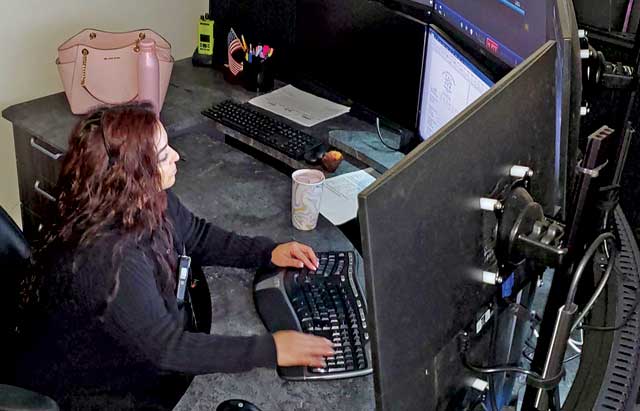
Shift Supervisor Raelynn Villarreal enters information at Pecos Valley Regional Communications Center.
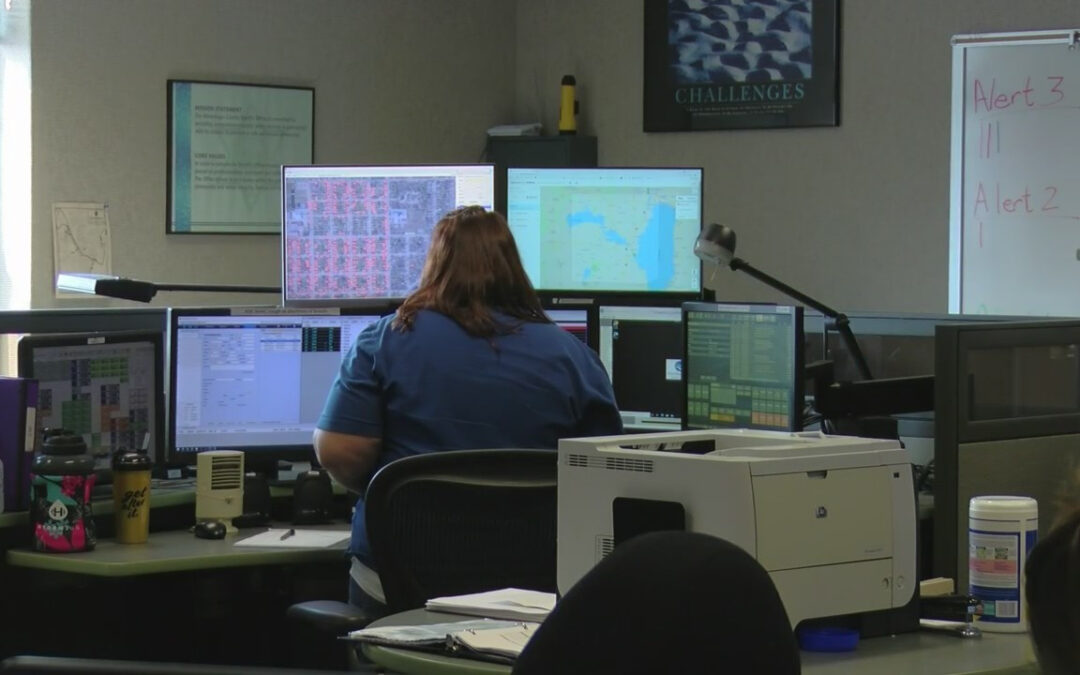
If you need help in an emergency in Roswell or anywhere else in Chaves County, chances are you will be talking to one of the dispatchers at the Pecos Valley Regional Communications Center. The telecommunicators of PVRCC answer all 911 calls made in Chaves County and dispatch emergency fire, police and medical services for the city of Roswell, Chaves County Sheriff’s Office, and all police, fire and EMS agencies within the county.
In all, PVRCC does the dispatching for 20 agencies consisting of 12 fire departments, five law enforcement agencies and three EMS services…
SAVANNAH, Ga. (AP) — Some Savannah-area residents are experiencing delays when they call 911.
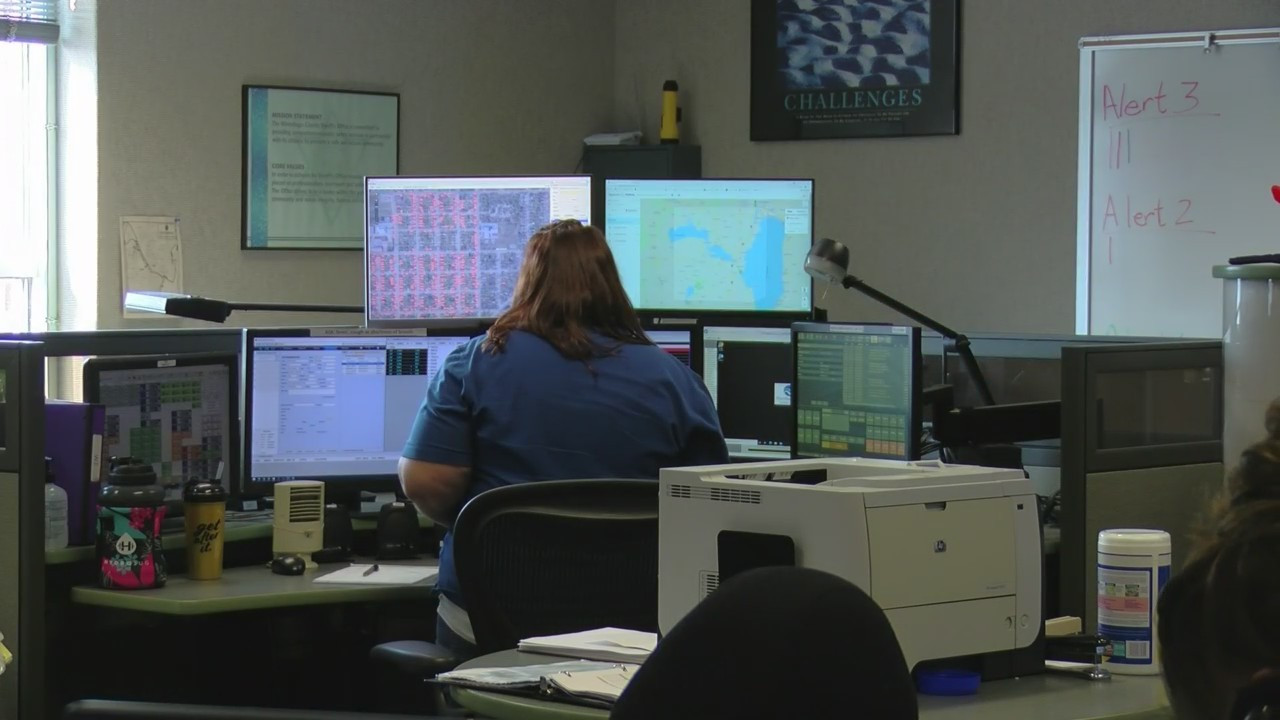
Chatham County Manager Lee Smith tells The Savannah Morning News that the emergency call center has about 20 vacancies for operators. A full staff is about 100 operators.
“It’s a major problem, but we’re not at a crisis yet,” Smith said.
People say that when they call, sometimes they get repeated rings. Former Savannah City Council member Julian Miller said he made several calls trying to report a person with medical problems along a city street…
Durham Police Service’s 9-1-1 call-takers and dispatchers had a very busy long weekend answering more than 6,000 calls from the public.
The majority of the calls were non-emergency reports, general inquiries and “hang-ups” that had to be called back. From Thursday, July 30, through to Tuesday, August 3, at 6 a.m., the communications centre received 3,035 9-1-1 calls (637 of these were hang-ups), and 3,664 non-emergency/general inquiry calls.
A police spokesperson said it was a “very busy weekend” in Durham for their “heroes in headsets” and staff answered all 6,699 calls with “professionalism and grace… READ MORE
MADISON, Neb. — The Madison County Commissioners discussed an outline of what the budget of the 2021-22 fiscal year will look like for the county on Tuesday.
While the budget has not been finalized, the meeting gave an opportunity for the commissioners to review past budgets of county organizations and make an outline based on that information.
“So today we set our schedule as far as how our timeline will go for the budget,” Madison County Commissioner Chair of Board Troy Uhlir said. “September 14, we have the overall hearing at 1 o’clock for the finalized budget for any public comment. Today we were very high-level overlooking expenditures from last year, proposed expenditures from this year. we’re looking pretty good as far as needed funds… READ MORE
FOX VALLEY, Wis. (WFRV) – 911 dispatchers are the heart of public safety operations and many are hiring across Northeast Wisconsin.
Staff Sergeant Erik Nielson of the Outagamie County Sheriff’s Office said, “We are hiring for the telecommunicator position for Outagamie County. I think the biggest thing for us is we’re looking for people that want to make public safety a career.”
Communications Captain Lara Vendola-Messer of the Winnebago County Sheriff’s Office said, “We’re actually sort of perpetually hiring. We keep an open application period and keep processes several times a year.”
The communications centers in Outagamie and Winnebago counties said while they are hiring they have enough people to ensure public safety but employees have to do overtime to keep them fully staffed…
Accenture (NYSE:ACN) and the Fire Department of the City of New York (FDNY) have developed a new computer-aided dispatch (CAD) system – FireCAD – replacing the now-retired STARFIRE system, and marking the most significant operational upgrade to the FDNY’s dispatch operations in 45 years.
FireCAD supports the dispatch and response of FDNY firefighters to fires and other public-safety-related incidents throughout the city’s five boroughs. It is a core platform underpinning the work of FDNY’s critical emergency services, which respond to more than 1.5 million 911 calls annually, serving more than 8.5 million residents in a 302-square-mile area…
Learn about current efforts to continue to protect the 4.9 GHz Band for public safety as well as recent filings, key decisions impacting these efforts, and how you can support PSSA’s initiative to protect the 4.9 GHz band for public safety.