Conway is a year-round tourist destination located in the White Mountains of NH, with a full-time population of 10,000. We are seeking highly a motivated individual to join our team, which consists of 34 full-time employees, making us one of the largest departments in Northern NH.
The Conway Police Department provides 24-hour emergency dispatch services for police, as well as five local fire/EMS departments. Duties include, but are not limited to: Telecommunications, answer multiple phone lines, meet and provide service to the public, receive emergency calls from the public and E-911, dispatch appropriate fire, ambulance or police using computer-aided dispatch, and monitor fire and burglar alarms…
GOLD BEACH, Ore. — The Curry County Board of Commissioners voted unanimously in support of funding the communications center, including upgrade of the 911 emergency response system for the Sheriff’s Department, the County said in a news release.
“The current system is dangerously outdated and not capable of providing critical service of public safety in the most remote areas of Curry County,” the County stated. “This puts our first responders at a disadvantage in responding as quick as possible to a citizen in need of assistance.”
As the Sheriff’s Office was prepared to make a presentation to the Board of Commissioners with needs for the updated system, pause to consider funding through ARP became a reality… READ MORE
Carrollton, Texas – The National Fire Protection Agency, or the NFPA, has issued requirements for many businesses which require the installation and maintenance of Public Safety DAS. These requirements are intended to enforce a base level of wireless connectivity in public spaces. This is to ensure a standard of connection quality that first responders can rely on in emergency situations. While the NFPA requirements have been stated clearly, many businesses find themselves non-compliant. Many more struggle to find a reliable company that offers quality DAS services in order to make themselves compliant…
Staring out the window and looking for flashing lights, Real Hebert said it felt like he spent an hour waiting for an ambulance when he called 911 on Jan. 15. His wife Simone Hebert’s breath had started coming in strange patterns and although her eyes were open, she was totally unresponsive.
MADAWASKA, Maine — Staring out the window and looking for flashing lights, Real Hebert said it felt like he spent an hour waiting for an ambulance when he called 911 on Jan. 15. His wife Simone Hebert’s breath had started coming in strange patterns and although her eyes were open, she was totally unresponsive.
It took 28 minutes for the Madawaska ambulance to respond from where it was, 28.5 miles away on Route 1, returning from transporting a patient to Cary Medical Center in Caribou. But that doesn’t mean it was any less traumatizing for Real Hebert, who waited on the line with 911 the whole time, cleaning up the saliva pooling in Simone’s mouth and pleading with the dispatcher for updates on the ambulance’s arrival…
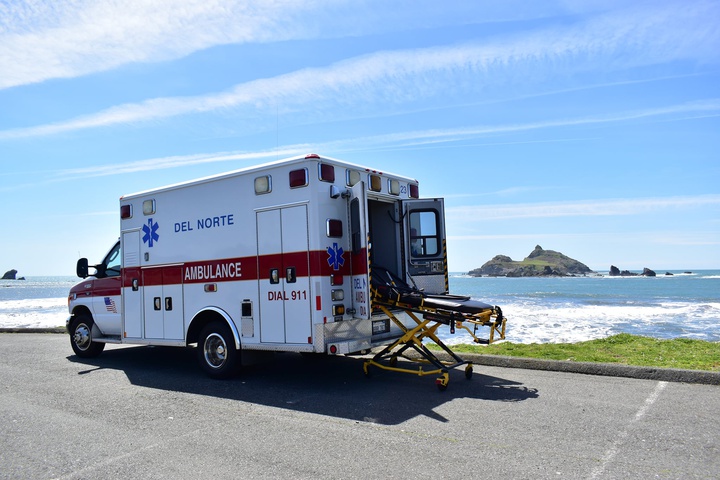
Del Norte Ambulance is transitioning to a new emergency medical dispatch system. Photo courtesy of Del Norte Ambulance
A partnership between Del Norte Ambulance and MetroWest has already led to updated equipment, easier access to training and education and a regional pool of paramedics to tap into should local responders be unavailable.
The relationship will also lead to a change Del Norte Ambulance owner Ron Sandler says he’s been wanting to make for 20 years — transitioning emergency medical dispatch away from the local system to one operated by Bay Cities Ambulance, based in Coos Bay, Oregon…
Spring, TX (July 01, 2021) – Harris County Emergency Services District No. 11 (HCESD11) announced today that construction is on schedule and training is now underway at the state-of-the-art 911 dispatch center that is on-track for a September 2021 opening.
Setting a new standard for dispatch centers in the state, the operation will feature innovative technology that enables dispatchers to work as efficiently and safely as possible. Arguably the most exciting new addition will be the incorporation of Logis, an intelligent computer aided dispatch solution with predictive AI deployment which uses historical data to make informed decisions that determine where to position ambulances, plus Long-Term Evolution (LTE) radios that utilize over 2,700 tower sites across Harris County. The new 911 dispatch center anticipates answering over 55,000 calls for service annually…
Learn about current efforts to continue to protect the 4.9 GHz Band for public safety as well as recent filings, key decisions impacting these efforts, and how you can support PSSA’s initiative to protect the 4.9 GHz band for public safety.