Jeremy Schmeltzer said he thought he was going to die on April 6 when he suffered a severe asthma attack while cleaning a guinea pig cage. The dander and dust aggravated his asthma and he was having a hard time breathing. When the attack hit, he tried his asthma inhaler. When that didn’t work, he tried his nebulizer. When that didn’t work, he called 9-1-1.
“That was probably the slowest time ever,” the 22-year-old Schmeltzer said. “I remember trying to unlock my phone, but I was so frantic and shaking that I couldn’t.”
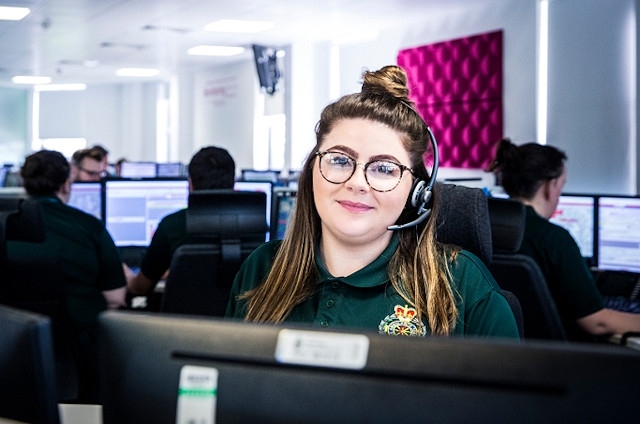
As part of a series created for BBC Bitesize, North West Ambulance Service (NWAS) Dispatcher Emily Blezard has been speaking about her role to inspire young people thinking about their careers.
As a dispatcher, 23-year-old Emily is responsible for around 20 ambulances in and around central Manchester, making tough decisions to ensure that ambulances are quickly sent to those patients most in need of help.
She is the main point of contact between the ambulance crew and control room which means that communication and multi-tasking are crucial skills.
Emily says: “I did languages at school which I think has really helped me as a dispatcher as it gave me practice to communicate under pressure, think on my feet and be able to give an answer when there’s an unexpected question.”
Inspired by her mum and dad – both of whom also work for NWAS – Emily decided to follow suit and begin her career helping those in their time of need.
The U.S. House of Representatives today approved a bill to correct the federal government’s occupational classification of 9-1-1 professionals and accurately recognize them as an essential part of the public safety community.
The “911 Supporting Accurate Views of Emergency Services Act” (911 SAVES Act, H.R. 1629), sponsored by Reps. Norma Torres (D-CA) – a former 9-1-1 dispatcher herself – and Brian Fitzpatrick (R-PA), would direct the White House Office of Management and Budget (OMB) to reclassify 9-1-1 telecommunicators and dispatchers in the federal government’s Standard Occupation Classification System.
The government currently classifies these occupations as “administrative/clerical” in nature, which is inaccurate and a disservice to the specialized, lifesaving work that 9-1-1 professionals perform every day. On any given day, these individuals provide emergency medical instruction; deal with suicidal persons; analyze background noises and a caller’s voice to assess a situation; coordinate the dispatch and safe arrival of field responders; and play a critical role in responding to emergencies large and small.
“On behalf of more than 100,000 9-1-1 professionals across the nation, NENA: The 9-1-1 Association thanks Reps. Torres and every member of Congress who supported this important measure,” said Brian Fontes, CEO of NENA. “Our members have long advocated for an accurate statistical classification for 9-1-1 professionals to support critical research into the mental and physical impacts of 9-1-1 jobs.”
“Now the action moves to the U.S. Senate, where we hope all members will support this non-partisan, cost-free measure that reflects the respect and support the American public has for its 9-1-1 professionals, who answer more than 240 million calls for help every year.”
CARTHAGE, Mo. – Kima Burnett has been a dispatcher with Jasper County Emergency Services for 22 years.
In that time she’s taken more stressful calls than she can count.
Kima Burnett, Trainer, Jasper County Emergency Services: “Calls involving children are hard. Taking a call from someone I knew reporting a suicide.. that was very hard. Taking a call from someone that went back into a burning building and I was on the line with her for her last breaths.. not realizing until after the fact when a responder let me know that happened. Lots of hard calls over the years.”
Burnett says a big part of what makes the job hard is not knowing what happens after they hang up the phone.
In fact, research posted in the Journal of Traumatic Stress in 2012 shows more than 30 percent of dispatchers experience high levels of stress after major calls, and links some of it to a lack of closure.
Burnett: “So a lot of it on our part is speculation, trying to play the what if game in our head and try to figure out what could have transpired. And over a period of time, that not knowing can really take a toll.”
Supervisors with the Jasper County Sheriff’s Office have started new efforts to change that.
The bill would reclassify 911 dispatchers as Protective Service Occupations
FREDERICK COUNTY, Va. (WDVM) — Lawmakers in Washington, D.C. are considering a bill to change the classification of 911 operators, a move dispatchers say would be a positive change in a stressful field.
According to the U.S. government’s Standard Occupational Classification System, 911 dispatchers are considered secretarial positions — making them different than first responders.
“We do so much more than answer the phone,” said Tara Vann, the second shift supervisor at the Frederick County Emergency Communications Center. “We’re the thin gold line. We’re the line between the blue and the red that kind of keeps it all together.”
House Bill H.R. 1629, also known as the 911 Saves Act, would change the classification, making the role of a dispatcher a Protective Service Occupation. The bill, introduced by former 911 dispatcher and now California Congresswoman Norma Torres, would also allow dispatchers to retire at an earlier point in their career, equivalent to those in law enforcement or fire rescue.
Learn about current efforts to continue to protect the 4.9 GHz Band for public safety as well as recent filings, key decisions impacting these efforts, and how you can support PSSA’s initiative to protect the 4.9 GHz band for public safety.