by AllThingsECC.com | Jun 6, 2021 | Comm Center News
MONTICELLO – Sullivan County Public Safety Commissioner Rick Sauer has resigned from his position effective July 9 and will become the emergency services director for Sampson County, North Carolina.
Sauer served as Sullivan County commissioner of Public safety for the past 3 ½ years and for the past 30 years as a member of several different organizations including the State Police and Liberty Fire Department. “It has been a very difficult choice to move on, but I think it is the best decision for my family,” he said.
Sauer has served as commissioner since 2017, overseeing the 911 communications center, probation, emergency medical services, fire services and emergency management…
by AllThingsECC.com | Jun 6, 2021 | Comm Center News
The city of Fairbanks has four union collective bargaining agreements (CBA’s) covering most of the 182 authorized positions. Some of these contracts are fairly easy to negotiate, but others take much more time. It is difficult for new council members to read the lengthy contracts and to thoroughly understand them. There has been much discussion in the past about trying to reduce the number of CBAs, but each is unique to the department they cover making any consolidation impractical.
The Police Department and Communications Center are covered by a contract with the Public Safety Employees Association (PSEA) with the exception of the police chief who is in the IBEW bargaining unit. Last year, an effort was started to separate out just six employees from this unit and form a fifth CBA entitled Fairbanks Police Command Unit (FPCU). Ordinance number 6169 is currently in front of the City Council to create this unit and advanced on a 4 to 3 vote to a public hearing on June 14…
by AllThingsECC.com | Jun 6, 2021 | Comm Center News
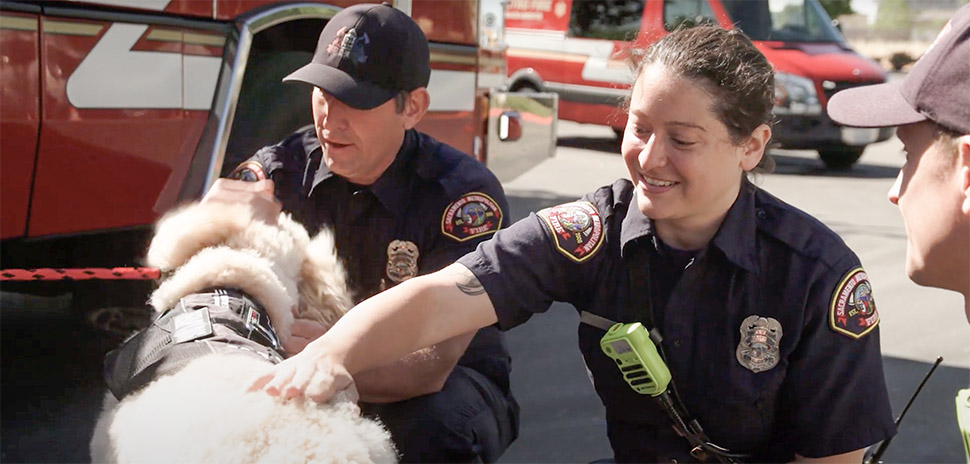
Storm season is coming with potential disasters from coast to coast. But this year, first responders won’t have to face them alone. AT&T’s FirstNet has stationed more than 30 trained Labradoodles nationwide to offer them support on the front lines—easing the depression and anxiety that can come with disaster response.
AT&T’s FirstNet is the only nationwide, high-speed broadband communications platform built for America’s first responders and the public safety community, with a dedicated, nationwide fleet of 80+ land-based and airborne portable cell sites. Its Response Operations Group (ROG) deploys the system in disasters, allowing first responders to make rescues and communicate even in the hardest-hit remote areas. More than 16,000 public safety agencies and organizations subscribe to FirstNet, accounting for more than 2.2 million connections nationwide…
by AllThingsECC.com | Jun 6, 2021 | Comm Center News
The seasonally adjusted unemployment rate in Kansas was as high as 12.6% in April 2020.
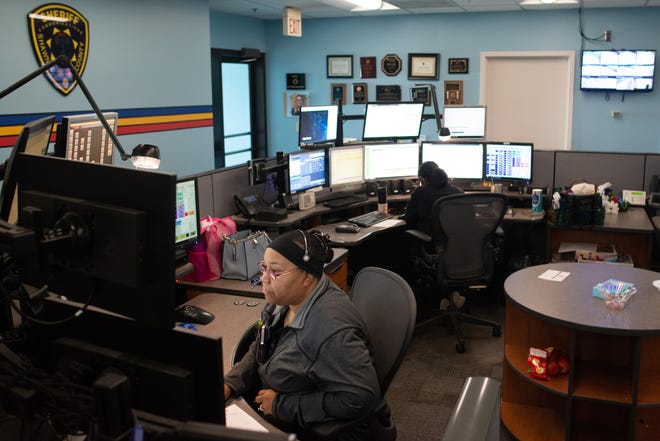
And the COVID-19 pandemic brought higher-than-usual unemployment rates, which Melanie Bergers and the dispatch center in Shawnee County were hoping would mean an increase in applications for open positions.
No such influx of job inquiries ensued.
Bergers, director of communications at the Shawnee County Sheriff’s Office, said the dispatch center was understaffed throughout 2020 and 2021, and typically paid about 600 hours of overtime every two weeks for the past year…

by AllThingsECC.com | Jun 6, 2021 | Comm Center News
On top of the normal stress that comes with the job, many North Texas 911 dispatchers have also had to deal with extended work hours.
They’re filling the gaps created by the number of dispatcher vacancies many cities, including Lewisville, are experiencing.
Kevin Deaver, Lewisville police chief, said the city’s dispatch team has been short of bodies for about six years. Currently there are 20 positions but five are vacant and four are in a six-month training period… READ MORE
by ECC Editor | Jun 5, 2021 | Comm Center News
Emergency communications went digital Thursday afternoon, after the Dukes County Sheriff’s Office implemented an upgrade to its aged communications system.
Sheriff’s office employees, along with engineers and technicians that helped install the new system, gathered at the Dukes County Regional Emergency Communications Center to listen as Sheriff Robert Ogden tested the new system… READ MORE