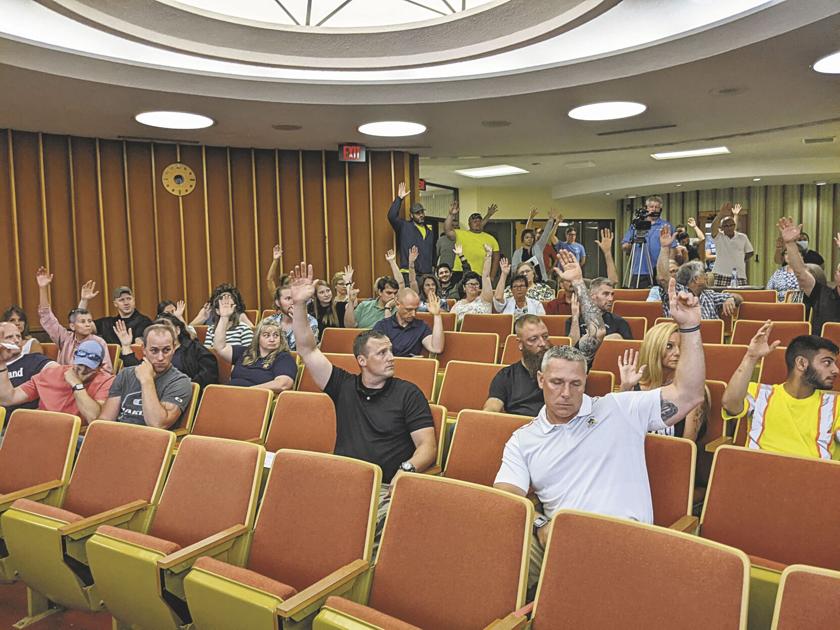
A town hall meeting hosted by Meadville City Council on Wednesday to discuss the future of Meadville Police Department’s dispatch staff was scheduled for 90 minutes but ended in about half that time: It didn’t take long to reveal the overwhelmingly clear consensus.
Those in attendance — seemingly every single one of them — wanted the city to keep its own staff rather than allowing Crawford County Public Safety to take over dispatching duties for city police…
CUMMING, GA — The Forsyth County 911 Center was recently awarded the Commission on Accreditation for Law Enforcement Agencies, known as CALEA, Public Safety Communications Re-Accreditation and was recognized for the accomplishment by the Forsyth County Board of Commissioners during their June 3 meeting.
Forsyth County is one of 11 Georgia 911 Centers that currently holds the CALEA Public Safety Communications Accreditation. Accreditation lasts for four years, during which the agency must submit annual reports attesting continued compliance with assessed standards. The county was last awarded the accreditation on Nov. 5, 2016…
If an emergency happens on base, who do you call? Meet the Emergency Communications Center Airmen.
The team consists of the fire officer, Base Defense Operations Center controller, and ECC NCO in charge who work together to quickly respond to emergency situations.
Staff Sgt. Luis Gonzalez, 341st Civil Engineer Squadron ECC fire officer, works as the base 9-1-1 operator. He answers the emergency calls, determines the nature of the emergency and dispatches the correct fire or medical response teams…
Last year’s protests may not have resulted in the dismantling of the Seattle Police Department, but as of June 1, they have produced one small shift: Seattle’s 911 dispatch is no longer housed within SPD. Instead, the unit is now a part of the Community Safety and Communications Center (CSCC), a new, independent city department that will, in theory, eventually house other civilian crisis response and public safety programs.
The move isn’t likely to have an immediate impact on who responds to emergency calls; for now, elected officials and advocates for downsizing the police hope that it will leave the door open for more significant changes…
Last week, I joined the final day of training for the new teams who will soon begin responding to 911 mental health calls in East Harlem and Harlem. Through this pilot program – the Behavioral Emergency Response Assistance Division or B-HEARD – mental health professionals will be part of 911 response for the first time in New York City history. It’s part of our commitment as a city to treat mental health crises as issues of public health, not public safety.
As we planned our pilot, we consulted with many practitioners and advocates around the city and country, including Correct Crisis Intervention Today in NYC (CCIT-NYC). We looked at health-centered responses in places like Denver, San Francisco, Harris County, and Toronto, as well as the long-running CAHOOTS program in Eugene, Oregon, to develop our model: small teams of emergency medical technicians/paramedics and behavioral health clinicians responding to non-violent mental health calls that come through the 911 system…
CALEA re-accreditation demonstrates commitment to excellence The Forsyth County 911 Center was recently awarded the Commission on Accreditation for Law Enforcement Agencies (CALEA) Public Safety Communications Re-Accreditation and was recognized for the accomplishment by the Forsyth County Board of Commissioners during their June 3, 2021, meeting. Forsyth County is one of eleven Georgia 911 Centers that currently holds the CALEA Public Safety Communications Accreditation. Accreditation lasts for four years, during which the agency must submit annual reports attesting continued compliance with assessed standards. The County was last awarded the accreditation on Nov. 5, 2016. “To achieve the re-accreditation, the County needed to meet over 200 standards during the review process,” said Forsyth County EMA and 911 Center Director Chris Grimes…
Learn about current efforts to continue to protect the 4.9 GHz Band for public safety as well as recent filings, key decisions impacting these efforts, and how you can support PSSA’s initiative to protect the 4.9 GHz band for public safety.