Integrating FirstNet into 911 Operations

By Kristi Wilde, Senior Public Safety Advisor

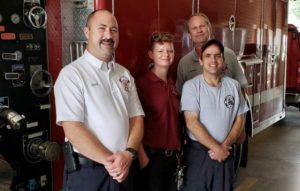
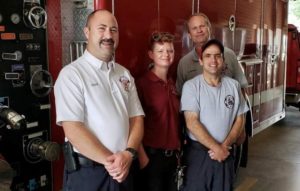
The FirstNet Authority continues to engage public safety from every discipline to better understand what they need from the FirstNet network. The FirstNet Authority talked with professionals working in emergency communication centers (ECCs)—sometimes called 911 centers or public safety answering points (PSAPs)—at Arizona’s Public Safety Broadband Forum for PSAPs (“Forum”) in Phoenix, Arizona in late August.

The event, hosted by the Arizona Department of Administration, was geared towards understanding how emergency communications professionals in Arizona are using FirstNet today and helping them learn how to integrate FirstNet into their 911 operations. Though voice communications are traditionally constrained to landlines and land mobile radios, ECCs are expanding how they communicate. The FirstNet Authority talked with ECC professionals at the Forum to understand how they are using data to communicate with the public and with responders in the field.
READ FULL ARTICLE

Harnessing FirstNet to enhance EMS response and improve patient care

Harnessing FirstNet to enhance EMS response and improve patient care

By Brent Williams, Senior Advisor for EMS, First Responder Network Authority

With the arrival of FirstNet, emergency physicians, paramedics and emergency medical technicians (EMTs) now have access to the nation’s first wireless broadband network dedicated to emergency communications with advanced broadband capabilities.

As the emergency medical field continues to adopt more complex assessment and diagnostic tools, reliable broadband is more important than ever to access actionable information when administering remote care via community para-medicine programs and mobile integrated healthcare.
READ FULL ARTICLE

WHEN 9-1-1 IS NOT ENOUGH: TRANSITIONING THE 9-1-1 CENTER INTO A MULTI-CHANNEL EMERGENCY COMMUNICATIONS CENTER

Disasters, terrorist attacks, and network outages have demonstrated the limitations of the 9-1-1 system. Emergency communications centers that remain focused on 9-1-1 as the singular emergency reporting channel fall short of providing a comprehensive emergency response solution in their communities. A change is required to adapt to the modern means of communications, such as text and picture messaging, livestream video, crowdsourcing, apps, sensors, and social media. This thesis reports on the actions taken to transition an emergency communications center into a multi-channel environment capable of building resiliency, and provides supplemental reporting channels, creates situational awareness, and builds more efficient workflows. Using business model generation and lean strategy methodology, this thesis provides a model for implementation strategies and proposes a bottom-up approach to meet individual community needs. This thesis recommends a pathway to shift the culture and strategy in carrying out the mission of emergency communications and responding to requests for emergency services.

Drilling Down Some Key Differences Between FirstNet and Verizon

By Richard Mirgon

I haven’t commented much in the past few months on Verizon’s efforts to maintain their presence in the public safety market and to compete with FirstNet. Much of what they have had to say is not much more than “me too” statements. As FirstNet grows and innovates, we hear a lot from Verizon about “I can do that” and “we’re the same” or as I like to say “me too”. Well as we know, they aren’t the same and they aren’t doing everything FirstNet can do.

Just to cover a couple of the basics, Verizon is a commercial network driven by stockholders and stock price. FirstNet as we all know is owned by public safety and governed by an independent board of directors, which includes first responders, and is housed under the U.S. Dept of Commerce. It has a robust public safety advisory committee made up of first responders. This is officially called the FirstNet Authority and more information is available on them at www.Firstnet.gov. AT&T is the entity that won the competitive contract to build and operate the network on behalf of the FirstNet Authority using spectrum owned by public safety via the FirstNet Authority. It should also be noted that there is no public documentation indicating that Verizon bid to build FirstNet.  I would also like to point out that when you pay your FirstNet bill a portion of that fee goes to the FirstNet Authority for its annual operation. With any other carrier such as Verizon 100% of your payment stays with that carrier to support their stockholders.

Recently, Donny Jackson did an interview (https://urgentcomm.com/2019/08/20/verizon-optimistic-about-position-in-the-public-safety-marketplace-company-exec-says/) with Mike Maiorana, Senior Vice President for Verizon’s public-sector unit, therefore I thought I would take this opportunity to offer some clarification or contrast on some of the points made by Maiorana.

One of the opening statements made was regarding how their “customer segment has trusted” them. I can only imagine that it is not the customer segment whose bandwidth they throttle during major disasters; nor is it the customer segment whose wireless service they shut down; nor is it the 911 network customers they had previously. (All this is clearly documented in my other editorials posted on this site.) As much as they clearly have a segment of customers who trust them, that universe has shrunk. Verizon has a clear history of focusing on the bottom line and abandoning public safety customers when it’s in their financial best interest.

Another point I find interesting is their ability to put “lipstick on a pig”. Maiorana talks about all the contracts they have won and to be fair he noted that they are multi-award contracts, but the fact is in one case they clearly lost to FirstNet. You see Verizon had an exclusive contract in Massachusetts which is why their market share is so high. What isn’t said is that FirstNet won on the new award also and is now on the State Contract.  Another statement was “We do have extremely high market share in the Commonwealth of Massachusetts … I would never commit to all, but it’s pretty close to all. This is a great indication that they want to keep it that way.” Now that it is no longer an exclusive for Verizon, let’s check back in a year and see how that worked out for them.

Maiorana goes on to make a number of statements about partnerships with companies like Axon, application development, mission critical push to talk, all of which are nothing more than “me too” statements. None of this would have risen to its current level if FirstNet had not been born. They do this simply to stay competitive and once it doesn’t pencil out in their bottom line it’s gone. I also think there is one significant question that hasn’t been asked or answered. How do you have mission critical push to talk or any mission critical application when public safety doesn’t have guaranteed, always on, top tier priority and preemption on the network? How do you do this without a hardened, dedicated, physically separated dedicated core? I am not a network engineer but my guess is you can’t.

Then the topic turns to deployables – a battle or debate Verizon can’t win. Maiorana is quoted as saying “deployables are not new,” noting that “Verizon has been using them to support public safety for years.” First off, note the word “support” indicating public safety isn’t the primary customer for their deployable. It is simply that they can be used for public safety. Everyone should understand that all carriers have deployables and they are designed with the intent to support network restoration in times of disaster that impact a carrier’s core network. They are not designed with the intent to be solely for public safety. The contrast here is that FirstNet has 72 dedicated public safety deployables available nationwide for FirstNet customers. These are built and designed exclusively for FirstNet public safety customers and are available at no charge to customers for disasters and planned events. Maybe Verizon will make this a “me too” offering for their public safety users.

Okay, so Verizon does have a solution according to Maiorana, “If a government agency wants to control and have in their fleet of assets a deployable, we will sell or lease them one.” Yep, you too can own your own Verizon deployable for a small fee of $100,000.00, $200,000.00 or more.

There is one thing I clearly agree with Maiorana on and it is that this segment is growing and I do believe a company can lose market share and still grow in this new market. The reason why is that we are now seeing more use, development and innovation in the public safety community/market. I also agree competition is good and provides public safety benefits. More than we have ever seen before, companies are stepping up to support public safety because they have found they benefit by doing so. But let’s understand that this has become a reality because of FirstNet, period.

Let me close by saying that I believe Maiorana does a respectful job of trying to move his company forward to benefit public safety. At the end of the day Verizon may believe it is “dedicated” to public safety, but the fact remains FirstNet “is Public Safety”.

Richard Mirgon is a Public Safety consultant focused on FirstNet. He is a Past President of APCO International and has over 35 years of public safety and first responder experience. For more information about the author please go to http://www.next-paradigm.com/about/

The views and opinions expressed in this article are solely those of the author and do not necessarily reflect the official policy or position of this company or any company with whom the author may be associated.

Tactical Dispatch Team: Your Job on the Other Side of the Console

Tactical Dispatch Team: Your Job on the Other Side of the Console

Tuesday, August 13, 2:45 p.m. – 3:45 p.m.
Presenters: Jonathan Jones, Athens-Clarke County Police Department; Tyrell Morris, Orleans Parish Communications District

This session offered a unique look into tactical dispatch teams that respond with field units, as well as those that operate out of the center. Attendees were able to take lessons learned from the Athens-Clarke County 9-1-1 as they developed their team as well and those lessons learned when Orleans Parish utilized their team during Madi Gras.

What makes tactical dispatch different than our everyday operations? Tyrell Morris stated that tactical dispatchers operate with a specific task or operation in mind. This task may be water rescues during a flash flooding outbreak, high-risk warrant services, SWAT/SRT operations and other like operations. These teams take the special operation workload off the center’s floor, reducing the call load and tasks of the rest of the communications staff.

Are Samsung Smartphones a Threat to Axon Body Cams?

Are Samsung Smartphones a Threat to Axon Body Cams?

At least one law enforcement agency is using the devices as body cameras, and more could follow

By Rich Duprey

Calls for greater police accountability and for protecting officers from false accusations have made body cameras must-have equipment for law enforcement agencies. Because Axon Enterprise(NASDAQ:AAXN) had already saturated the stun gun market with its Taser weapons, it moved into the body cam field as a means of extending growth opportunities, and has now come to dominate it as well.

Yet the announcement that one Colorado sheriff’s department is testing a different kind of body cam system has the potential to completely upend Axon’s dominance.

This article was written by Rich Duprey and appears on fool.com dated August 9, 2019

To read the full article please click on the button below.
READ FULL ARTICLE