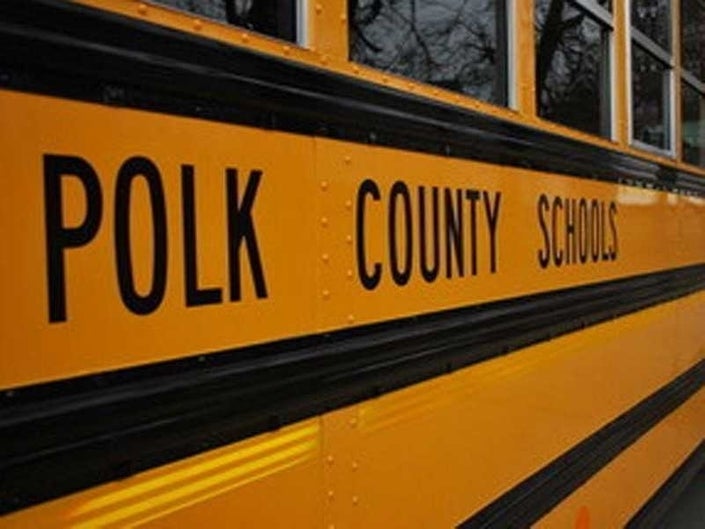
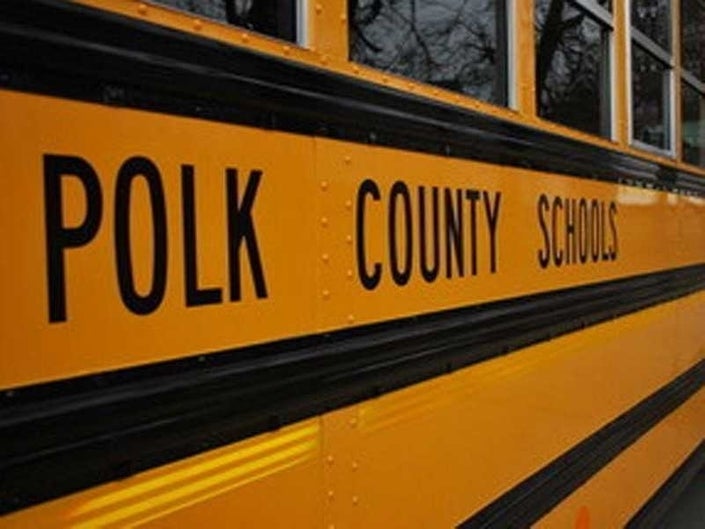
Bus drivers and attendants on Polk County Public School buses will have a new way to contact 9-1-1 .
BARTOW, FL — Bus drivers and attendants on Polk County Public School buses will have a new way to contact 9-1-1 during the upcoming school year.
“Polk County Public Schools is upgrading the radios on our fleet of buses and support vehicles,” explained district officials.
While the new fleet radio system is expected to be in place by the start of the school year, the media was given a look at the installation process on Wednesday at the district’s support services building in Bartow.
Recall is due to ‘dramatically understaffed’ 911 dispatch center
Brian Carder spent 17 years with the North Chicago Police Department — and his tenure with the force took a toll on his body, WBBM-TV reported.
“I got hit by a car once,” he told the station. “Well, actually twice.”
Carder said he suffered a broken hand, broken collarbone, “a couple concussions,” and underwent two hip replacements as an officer, WBBM reported.
Finally he was diagnosed with PTSD in 2009 and approved for a line-of-duty disability pension — his only source of income — and health benefits, the station said.
The 911 SAVES Act would reclassify dispatchers from ‘Office and Administrative Support Occupations’ to ‘Protective Service Occupations’
WASHINGTON, D.C. — The U.S. House of Representatives voted to add a provision to the National Defense Authorization Act for FY2020 that would reclassify 911 dispatchers from Office and Administrative Support Occupations to Protective Service Occupations.
The 911 Supporting Accurate Views of Emergency Services (SAVES) Act now moves to the Senate. If passed, 911 dispatchers would be reclassified in the Office of Management and Budget (OMB) Standard Occupational Classification (SOC) catalog.
U.S. Representatives Norma J. Torres (D-CA), a former 911 dispatcher, and Brian Fitzpatrick (R-PA), a former FBI supervisory special agent and federal prosecutor, spearheaded the legislation to change that designation of dispatchers.
“For more than 17 years, I lived through the challenges and stress 911 dispatchers experience 24 hours a day, seven days a week. Dispatchers are a critical link in the public safety chain that helps firefighters, EMTs, and law enforcement officers do their jobs every day,” Torres said. “I’m proud that the House took this important step forward to give the nation’s 100,000 public safety telecommunicators their due and reclassify them as the protective service occupations that they are.”
Fire and police departments have been leveraging LTE to increase their response times, improve interdepartmental communications, and provide connections to FirstNet and other national public safety broadband networks. Wireless connectivity has been opening doors to new technologies to help public safety agencies better meet their needs and keep their communities safer.
Similar opportunities exist for emergency medical service departments. EMS teams provide vital services to their communities, and we are now seeing an upswing in EMS adoption of mission-critical connected technologies.
This article was written by Estee Woods and appears in ems1.com dated July 16, 2019.
To read the full article please click on the button below.
Jeremy Schmeltzer said he thought he was going to die on April 6 when he suffered a severe asthma attack while cleaning a guinea pig cage. The dander and dust aggravated his asthma and he was having a hard time breathing. When the attack hit, he tried his asthma inhaler. When that didn’t work, he tried his nebulizer. When that didn’t work, he called 9-1-1.
“That was probably the slowest time ever,” the 22-year-old Schmeltzer said. “I remember trying to unlock my phone, but I was so frantic and shaking that I couldn’t.”
The U.S. House of Representatives today approved a bill to correct the federal government’s occupational classification of 9-1-1 professionals and accurately recognize them as an essential part of the public safety community.
The “911 Supporting Accurate Views of Emergency Services Act” (911 SAVES Act, H.R. 1629), sponsored by Reps. Norma Torres (D-CA) – a former 9-1-1 dispatcher herself – and Brian Fitzpatrick (R-PA), would direct the White House Office of Management and Budget (OMB) to reclassify 9-1-1 telecommunicators and dispatchers in the federal government’s Standard Occupation Classification System.
The government currently classifies these occupations as “administrative/clerical” in nature, which is inaccurate and a disservice to the specialized, lifesaving work that 9-1-1 professionals perform every day. On any given day, these individuals provide emergency medical instruction; deal with suicidal persons; analyze background noises and a caller’s voice to assess a situation; coordinate the dispatch and safe arrival of field responders; and play a critical role in responding to emergencies large and small.
“On behalf of more than 100,000 9-1-1 professionals across the nation, NENA: The 9-1-1 Association thanks Reps. Torres and every member of Congress who supported this important measure,” said Brian Fontes, CEO of NENA. “Our members have long advocated for an accurate statistical classification for 9-1-1 professionals to support critical research into the mental and physical impacts of 9-1-1 jobs.”
“Now the action moves to the U.S. Senate, where we hope all members will support this non-partisan, cost-free measure that reflects the respect and support the American public has for its 9-1-1 professionals, who answer more than 240 million calls for help every year.”
Learn about current efforts to continue to protect the 4.9 GHz Band for public safety as well as recent filings, key decisions impacting these efforts, and how you can support PSSA’s initiative to protect the 4.9 GHz band for public safety.