Super Bowl LI: FirstNet After Action Report

Harris County Texas After Action Report of the operational use of the Harris County LTE system at Super Bowl LI – the first large scale event to formally incorporate mobile data communications and operations plans.

[su_button url=”https://hclte.harriscountytx.gov/Documents/SBLI%20FirstNet%20AAR%20Final.pdf” target=”blank” style=”flat” background=”#005a8c” radius=”0″ class=”.button-sc”]ACCESS FULL REPORT[/su_button]


Artificial Intelligence for us?

Artificial Intelligence for us?

Have you ever wondered how Netflix knows what movies to recommend for you—or realized that if it is suggesting kids’ movies, that means someone else in the house must have been using your account? It turns out that this sort of technology, which relies on what is called “big data,” is also useful for calltaking and emergency response.

Consider the size of the data that we collectively work with. Based on some available information, if there were global coverage of emergency numbers, there would be approximately seven billion emergency calls (911, 999, 998, 997, 112, 111, 102, etc.) per year worldwide. That is around one call per person on average, although some studies have found that the repeat callers account for a larger portion of the calls, with more than two calls per year on average from each person that called. In any case, this generates huge amounts of data, more than enough to qualify as “big data.”

Not unlike that Google search, imagine the day in the not too distant future when you’ve began to type the caller’s problem statement, and the ProQA software knows what the caller’s answers are likely to be and autocompletes them before you have even asked all the questions. I predict that day is coming soon, although this kind of system requires large amounts of data to work from. How can that be possible? Let’s take a brief look at how these systems work and how they might improve the accuracy and speed of your calltaking process.

In 1950, Alan Turing, a famous computer scientist, wondered, “Can computers think?” He proposed answering this question with the so-called Imitation Game. In this game, an interrogator would ask two players (one a human and the other a computer) a series of questions designed to determine which of the two players was the computer and which the human. If they reached the point where the player could not tell the difference between the two players’ answers, it would be determined that computers can, in fact, think.

Now, imagine a time in our near future when the computer’s flawless memory and calculations are available to the very real and human calltaker. Using Machine Learning (ML) tools, also known as Artificial Intelligence (AI), these computers will recognize patterns that you did not even know existed—and do it almost instantly, starting with the phone ring. Complicated patterns and connections could be discovered that would be too difficult for a human to identify separately.

Although we recognize patterns all the time, as humans we only have the capability to handle a limited number of variables, while ML/AI tools can very quickly identify patterns across 15, 50, 100, and even thousands of different inputs and determine precisely what is important and what is not. If you were to draw out these concepts visually, it would look like a map of our nervous system, or perhaps like a pattern of snowflake under a microscope. The purpose of using such pattern recognition, remember, is not to replace the emergency dispatcher—far from it. Rather, the process can recognize patterns across millions of calls, providing insight to the calltaker as they proceed through a call, similar to how doctors’ electronic decision support systems can offer them diagnostic and prescribing advice in real time.

One of the exciting aspects of this technology is that it is what is called a self-learning algorithm; that is, it gets more accurate as time goes on and it is presented with even more data. This kind of algorithm can learn from all dispatchers using the same system anywhere in the world simultaneously, and will learn what aspects of the calltaking and key questions might be regionalized or cultural, or even those that change depending on the type of emergency. The questions that you need ask and have answered might even change depending on the calltaker and the caller, customized for each scenario.

Another ML/AI method is known as Natural Language Processing (NLP), which aims to “understand” the meaning or intent of simple statements. When trained by humans, this method works well in handling text such as a physician’s or paramedic’s narrative in a medical record. It is less efficient, though, at handling information that is less structured, such as the dispatch problem description, which includes all forms of language, as well as word choices with multiple meanings.

Think about all the different responses you get when you ask “Okay, tell me exactly what happened?” Then consider how differently each calltaker might enter these responses into ProQA. As standard as data processing may seem, it is a process that works better when there is only one thing or one kind of thing happening. As you know, that often is not the case at dispatch.

For this kind of complex question, we might use a process known as clustering, which tries to identify the “chief complaint” or “call type,” so that everything that follows can be standardized.

For example, if the caller reports, “There was a shooting,” that will result in a rapid police response. If, however, the caller reports, “The victim is pulseless and not breathing,” you will instruct them to begin CPR and urgently send the paramedics. This system is designed to minimize the time required to determine what level, or priority, of dispatch is needed and what instructions should be given to reduce morbidity and mortality. However, at least for now, it does not tolerate ambiguity or changing circumstances very well.

That’s why, in my future work, I plan to evaluate several different algorithms that could be useful (behind the scenes) to help you more quickly and with more accuracy determine what responses are needed and which instructions should be provided.

Download PDF

Citation: Nudell, N. Artificial Intelligence for us? Annals of Emergency Dispatch & Response. 2017;5(1):5.

Challenges in Utilization of Statistical Analysis Software in Emergency Dispatch Data Analysis and Advances in Data and Technologies

Challenges in Utilization of Statistical Analysis Software in Emergency Dispatch Data Analysis and Advances in Data and Technologies

Introduction

Emergency dispatch and emergency medical services (EMS) data keeps increasing every day—in quality, volume, and dimensionality. An Emergency Medical Dispatcher (EMD) at an emergency communication center is the primary link between the public caller requesting emergency medical assistance and EMS. Data collection starts when the EMD receives the call and ends when the patient is either treated on scene or admitted to the hospital. The data collected is mostly structured data containing both text and numerical data types.

Data generated from emergency dispatch is very valuable, as we can gain extremely beneficial insights from the data, such as identifying ways to reduce response times, determining the most commonly encountered types of emergencies (or Chief Complaints), and understanding the text data entered by the EMD to describe the caller’s emergency problem. These insights in turn can help to evolve dispatch protocols and to design and implement better training for calltakers, dispatchers, and other emergency communication center staff. However, collecting and analyzing the data can present challenges. When attempting to apply one common statistical analysis software (called R) to one large dispatch dataset, we encountered challenges that are typical of those that researchers and data analysts will continue to encounter as dispatch data grows in size and dimensionality.

Challenges and Potential Solutions

There are many tools that can be used for general data analysis and reporting results. Some of the tools are Tableau, MicroStrategy, and QlikView. These tools can be used for data analysis and for developing dashboards where emergency dispatchers can keep track of Key Performance Indicators in real time, depending on when they refresh the data from the database. For more sophisticated statistical data analysis, there are tools such as SAS, SPSS, STATA, and R program, which enable researchers to develop prediction models or perform other complicated analyses. 

Even these programs, though, present their own difficulties. One of the problems with R program, for example, is that it was designed to have all of the data stored in memory—and it is memory-intensive. Emergency dispatch data can contain thousands of rows and can significantly exceed the memory of computers when we analyze large datasets. Hence, to alleviate memory problems, we need to split the datasets prior to analysis. However, splitting the data degrades the insights we can gather.

Another potential challenge for dispatch data analysis is so-called “Big Data.” Big Data can involve both structured and unstructured data, resulting in datasets greater than 1 terabyte (TB) in size. Big Data has three main characteristics: volume, velocity, and variety. Volume is the amount of data generated, velocity is how frequently data is generated, and variety refers to the number of types of data generated. Emergency dispatch data may already be categorized under Big Data based on volume, and sooner or later it will satisfy all three conditions. This is primarily due to the fact that, with time, as data volume increases, velocity also increases, because as population increases the total number of emergency cases may also exponentially increase. Also, as technology becomes cheaper, various other parameters may also be collected, which increases the variety of data. 

Big Data cannot be analyzed using regular tools such as R program, SPSS, STATA, or Tableau. Using regular analysis tools, we pull data from data sources and directly load it into the tools for analysis; this is not a problem when the dataset is small. However, when the dataset size is big, it is difficult to pull it from the source and load it into the analysis tool. Hence, the analysis tools or programs need to reside where the data is—at the source. This way, analysis is performed without moving the data from its source. Hadoop framework software is the commonly used Big Data technology that has gained the most momentum recently. Hadoop framework consists of Hadoop Distributed File System (HDFS) and MapReduce. HDFS enables the storing of data. It divides the data in to smaller parts and distributes the data across various servers or nodes. MapReduce software framework helps in processing the data in parallel in the cluster—in small, easily-managed and -processed chunks of integrated datasets. Numerous vendors such as Amazon Web Services, Coludera, Hortonworks, and MapR technologies distribute open source Hadoop platforms. These may eventually offer solutions to some of the dispatch community’s Big Data challenges.

Summary

Dispatch and EMS provide very rich data. Existing statistical analysis software tools can reveal trends and insights in that data that can help move dispatch forward. However, in the near future, as dispatch and EMS data get classified under Big Data, more sophisticated statistical tools such as Hadoop will evidently be needed in order to gain better insights in the data. Therefore, by keeping the growth in data (both size and dimensionality) in mind, it would be a rewarding investment to begin thinking about how to apply real-time analysis and reporting and big data technologies. 

Acknowledgement

Thanks to Chris Olola, PhD; Isabel Gardett, PhD; and Greg Scott, MBA, EMD-Q® for their mentorship and supervision of the pilot application of the concept of using R analysis tool to mine problem description data in emergency dispatch research.

Citation: Yerram SR. Challenges in utilization of statistical analysis software in emergency dispatch data analysis and advances in data and technologies. Annals of Emergency Dispatch & Response. 2016;4(2):5–6.

Download Original Paper

Topics:||

FBI National Data Exchange System’s On-Line Tool Enhances Dispatching by Law Enforcement Agencies throughout the US

The traffic stop began like any other. The officer radioed to dispatch with the license plate number and a National Crime Information Center (NCIC) search was conducted. The search turned up negative – showing nothing unusual about the vehicle or its owner – and the officer started a routine approach to the vehicle. The dispatcher then searched the license plate number through the Federal Bureau of Investigation’s (FBI) newest System, the National Data Exchange (N-DEx). for short. Moments before the officer reached the driver’s side window, dispatch returned with some relevant information – the vehicle had been associated with weapons charges only two months prior. With this new information, the officer implemented the protocol for a more dangerous situation, ordering the driver out of the vehicle with hands on his head. The subsequent search of the vehicle discovered a loaded, stolen weapon under the driver’s seat. A potentially disastrous situation was averted.

This hypothetical scenario demonstrates the potential of information sharing in the 21st Century. No longer do law enforcement and criminal justice professionals have to rely on limited information to do their jobs. Instead, they have a vast array of information on incidents, arrests, booking and incarceration, pre-trial investigations, as well as probation and parole information available to them with an authorized N-DEx account accessible via common web browsers.

The FBI’s National Data Exchange

The FBI’s N-DEx System contains data from local, tribal, state and federal agencies. It is available 24/7, 365 days a year. The FBI also bears the full cost of development and maintenance of the System. “N-DEx was the FBI’s answer to the 911 commission’s report calling for greater information sharing between all levels of law enforcement,” explains the N-DEx Acting Unit Chief, John Quinlan. Quinlan added that the men and women of the N-DEx Program Office are proactively engaging more and more agencies to further increase participation with N-DEx, both for obtaining more data, as well as increasing usage of the system.

N-DEx data types have evolved from incident reports to include other data types such as probation, parole, and booking reports, providing users with a wider array of investigative information. N-DEx became operational in 2008. Since then, N-DEx has been expanding capabilities incrementally. With these upgrades, version 2 of N-DEx had new features such as full text search, subscription and notification, enhanced link and geo-visualization, and collaboration features. However, version 3 of the system added new features such as the integrated person entity view, batch query, and also enhanced existing features. Subsequent N-DEx builds created roles for the Criminal Justice Information Services (CJIS) Systems Officers (CSOs) to manage personnel, audits, and training. Future builds will continue to expand and improve N-DEx capabilities, further meeting the needs of the user community.

Access to N-DEx is brokered through the FBI’s Law Enforcement Enterprise Portal (LEEP). Along with other services such as Regional Information Sharing Systems (RISS) and National Gang Intelligence Center (NGIC), LEEP also provides N-DEx as a service. After applying for and receiving access to N-DEx, law enforcement or criminal justice professionals can simply click on the N-DEx icon from LEEP and be taken to the default simple search screen of N-DEx, where they can craft key-word searches. One click away is the Targeted Person search where a name and other 36 Annals of Emergency Dispatch & Response | Volume 3, Issue 2 FBI National Data Exchange Program weighted identifiers, such as a date of birth, or Social Security Number, can be used to return all records in the system associated with an individual. In the case above, a license plate number was used to return any information associated with that vehicle.

N-DEx connects the dots between seemingly unrelated people, locations, property, offenses, and more. It correlates data within an agency’s own files and between the files of other agencies that contribute data. This powerful feature allows investigators to easily pull all records associated with an entity, and even view the associations in the form of a link diagram. Other site features include Geo-Visualization – placing a record or records on a map – as well as batch query capability, complex filtering options, and collaboration sites where other authorized users can share files of any size or type.

In an actual case in 2012, a Maryland Highway Patrol Officer stopped a truck transporting three storage containers. A search of the vehicle and driver information did not reveal useful information. The officer then took an additional step of searching the names on the bill of lading through the Law Enforcement Information Exchange (LInX). Because of the designed linkages between the two systems, this LlnX search automatically triggered a query of the N-DEx System. Within seconds, the N-DEx returned results indicating an individual associated with one of the containers was the subject of an ongoing federal investigation. In light of this new information, Maryland Highway Patrol Department was able to collaborate immediately with the Bureau of Alcohol, Tobacco, Firearms and Explosives (ATF) to track down the suspect. The vehicle was allowed to continue to its destination where the person under investigation was intercepted when he claimed the storage container. The contents included 3,000 cartons of counterfeit cigarettes; the suspect was subsequently charged and convicted of multiple crimes.

As of August 2015 the N-DEx System received files from over 5,300 agencies, containing approximately 500 million searchable records, and returns results for an average of 50,000 searches per week. As new users apply for access and begin incorporating N-DEx in their standard operations and as new agencies realize the value of having their data in the System, N-DEx will continue to grow in both size and usage. Each day new records are added to the NDEx System, creating new opportunities daily in the fight to solve and prevent crime. This is why the N-DEx Program Office will continue to actively pursue bringing on board new agencies and help new users conduct searches of the system. As Kent County Sheriff (MI), Lawrence Stelma says, “I get just as much benefit from having my records in N-DEx, as I do from using the system. Investigators from other jurisdictions are constantly bumping in to my investigations and assisting us in solving our county’s crimes.”

In this day and age, it is necessary to use all of the tools available in order to solve and prevent crime and promote public safety. N-DEx is one of those tools – a force multiplier – allowing users to access more information in less time. The N-DEx Program Office encourages police dispatchers to apply for N-DEx membership and utilize this valuable tool as they conduct their daily work. Together, partnerships between local law enforcement and the FBI can make the world a little safer place.

Authors note: To obtain N-DEx access, visit the LEEP at www. CJIS.gov and fill out the online application. If you already have a LEEP account, you can request N-DEx access by finding us in the “Services” section of LEEP and choosing ”Request Access”. For contributing data to the System, contact the N-DEx Program Office’s help desk at ndex@leo.gov and your request will be routed to the Liaison Specialist associated with your state. 2015 | Annals

Citation:Wertheim K, Badgett K. FBI National Data Exchange System’s On-Line Tool Enhances Dispatching by Law Enforcement Agencies throughout the US. Annals of Emergency Dispatch and Response. 2015;3(2):36-37.

Download Original Paper

Close Collaboration Between Public Health and Emergency Services Agencies Leads to an Effective Ebola Response in North America

Close Collaboration Between Public Health and Emergency Services Agencies Leads to an Effective Ebola Response in North America

911 agencies, Emergency medical services (EMS), and first responder agencies  play a critical role in major disease outbreaks because they are a gateway to the overall healthcare system for a wide spectrum of patients who use 911 as their first point of access. For those patients, emergency dispatchers and emergency prehospital responders are the first professionals to communicate with, treat, and provide hospital transport for, patients who are infected with communicable diseases. Public health agencies such as the Centers for Disease Control and Prevention (CDC) at the national level, and state and county health departments at the local level, or provincial health ministries in Canada, are responsible for developing the strategy and setting the policies and practices for managing disease outbreaks, infected patients, and those suspected to be infected. Members of these two professions – emergency services and public health – don’t necessarily interact on a routine basis, and differ substantially in the focus of their work. Given this reality, the recent Ebola outbreak tested the abilities of these two disparate groups to work in concert, in an effective and seamless effort to contain the spread of a novel disease. 911 centers in particular often receive little attention when it comes to a comprehensive public health response to disease outbreaks. Nevertheless, a critical role can be played by 911 agencies willing to review and modify day-to-day operations to contribute to the overall effort of specific disease information gathering as well as responder notifications.

During the summer of 2014, public health authorities around the world became alarmed over the rapid spread of a strain of Ebola Viral Disease (EVD) that had become widespread in several West African countries. By July 30, 2014, Guinea, Sierra Leone, Liberia, and Nigeria had together reported confirmed and suspected case counts totaling 1,440, with 826 reported deaths. On August 8, 2014, the World Health Organization (WHO) announced that this EVD outbreak was the largest ever recorded, and declared it a Public Health Emergency of International Concern. By August 26th, the case count had reached 3,069, with 1,552 deaths – all in a handful of West African countries.

But on September 30, 2014 the crisis suddenly reached a new level when the first case of EVD diagnosed in the United States was reported in Dallas, Texas, in a patient who had recently traveled to the United States from Liberia. Since one of the patient’s close acquaintances had called 911, and the patient was subsequently transported to the hospital by a Dallas Fire Department paramedic crew, the issue of prehospital care management of EVD cases was placed immediately into the public health – and media – spotlight. Following the Dallas case, the CDC moved quickly to implement a series of public health policies and procedures aimed at preventing the spread of the disease in the U.S. population, and protecting healthcare and emergency services workers who may come in contact with Ebola patients.

On August 26, 2014, the CDC, recognizing the value of emergency services – including 911 agencies – in dealing with a disease outbreak, posted its first version of a document entitled “Interim Guidance for Emergency Medical Services (EMS) Systems and 9-1-1 Public Safety Answering Points (PSAPs) for Management of Patients with Known or Suspected Ebola Virus Disease in the United States.” The primary goal of this document was to provide nationwide direction for prehospital and public safety professionals to follow standardized protocols and procedures for patient management and treatment of suspected EVD patients from the first point of contact with a public safety or healthcare professional, to final discharge from a medical facility. For 911 agencies (PSAPs) the CDC’s recommendation was for local authorities to direct emergency dispatch agencies to use “modified caller queries” about Ebola when the risk of Ebola becomes elevated. Specifically, 911 callers should be queried about:

• travel to or from an Ebola-infected country

• signs and symptoms of Ebola, such as fever, diarrhea, vomiting, etc. and

• Other risk factors, such as contact with someone who is sick with Ebola1

The CDC’s “Interim Guidance” was a good framework document for 911 agencies, yet for 911 centers to operationalize this recommended practice, required a specific calltaking protocol format, with scripted, ordered questions and instructions to use when receiving calls that involve potentially infected patients. To fill that need, the International Academies of Emergency Dispatch (IAED) took up the task of modifying its existing tool – the Severe Respiratory Infection (SRI) Tool – for querying 911 callers regarding infectious diseases.

The IAED’s Chemical Biological, Radiological, and Nuclear (CBRN) Fast-Track Committee – a subcommittee of the IAED Medical Council of Standards – was assigned the responsibility of creating a new template to address the points in the CDC’s guidance document. Formed shortly after the 2003 SARS (Severe Acute Respiratory Syndrome) outbreak in North America, the committee is made up of emergency medical services (EMS), public health, and 911 professionals, whose primary goal is to identify and evaluate emerging public health or public safety threats, and develop or update relevant emergency dispatch protocols and procedures for managing those threats.

The group’s biggest challenge during any novel disease outbreak is to stay ahead of the rapidly changing course of the disease, through a process of constant monitoring, teleconferencing and electronic communication among group members.

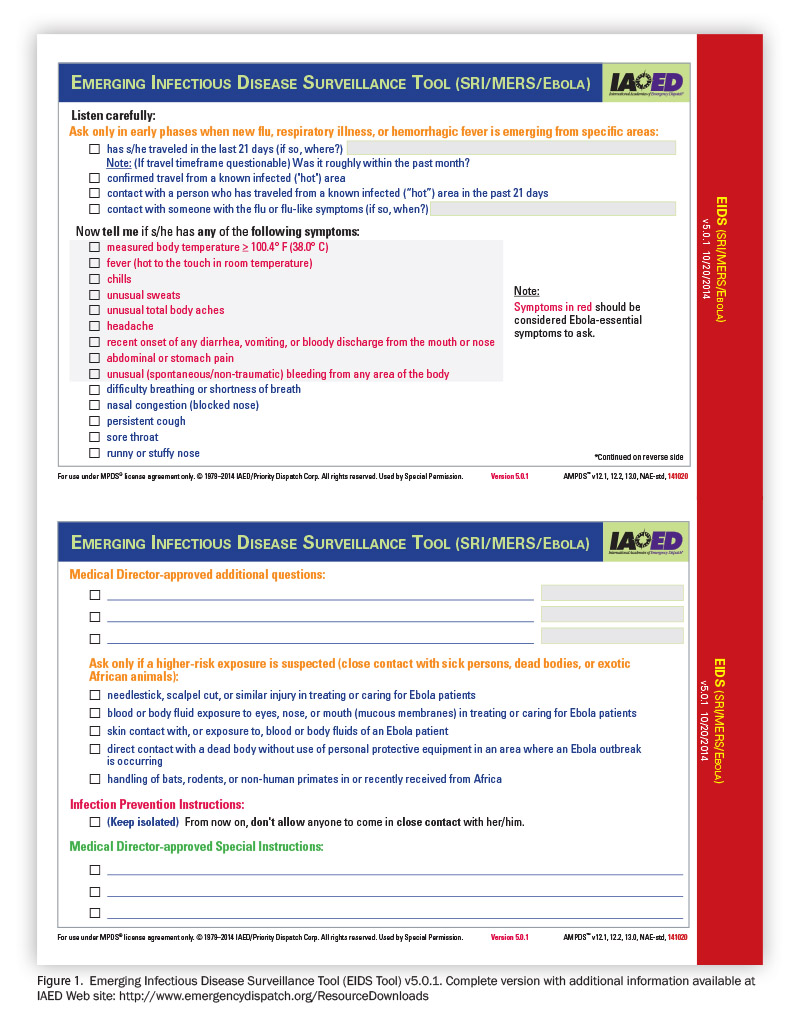
The committee had previously developed the SRI Tool for use in an outbreak of a flu-like, respiratory illness, such as SARS in 2003, or the H1N1 influenza pandemic in 2009. The SRI Tool was a useful template as a starting point, but EVD is categorized as a viral hemorrhagic fever, with a different pathology than these previous novel virus outbreaks. Further, the fact that EVD was transmitted through direct body fluid contact with a symptomatic patient as opposed to airborne transmission of the previous respiratory disease outbreaks, and the geographical concentration of the disease in West Africa, meant that specific caller/patient queries needed to be developed for detection of potential EVD patients. After reviewing the CDC recommendations, receiving input from user agencies, and discussing the content, wording, and ordering of specific questions and instructions, a final draft was developed by October 18th, less than three weeks after the first North American case had been confirmed in Dallas. The final version of the new protocol tool – renamed the Emerging Infection Disease Surveillance (EIDS) Tool (SRI/MERS/Ebola) (Figure 1) – was released to North American users on October 20th, and a week later the software version was released. It was also released to other countries in numerous languages shortly thereafter.

Having been involved in the IAED CBRN committee, and participating in conference calls with the CDC, NHTSA (the National Highway Traffic Safety Administration), the Paramedic Chiefs of Canada – and numerous conversations with dozens of 911 agencies whose managers, medical control authorities, and dispatchers, worked long and hard to implement an effective dispatch response to EVD – I am confident in saying there has been a widespread acknowledgement from all of the above stakeholders as to the importance of 911’s role in the response to an emerging disease outbreak.

Thankfully, EVD has not spread in North America, largely due to the rapid and well-coordinated actions of the key players at the national, state, and local levels – not the least of whom are our emergency responders and emergency dispatchers. It is clear therefore, that 911 centers, responder agencies, and public health can work together to implement a successful prehospital response for emerging disease outbreaks. National public health authorities from the CDC were able to provide guidance for emergency services, including EMS and 911. Specific protocols and procedures can be provided by an international standard setting organization, such as the IAED, if it moves quickly to respond to the public health emergency at hand.

Finally all stakeholder agencies must maintain an open line of communication, and be flexible enough to adjust and react to rapidly changing circumstances with well thought out actions.

TABLES AND GRAPHS

REFERENCES
Citation: Scott G. Ann Emerg Disp Resp 2015; 3(1): 5-7

Download Original Paper

  1. Centers for Disease Control and Prevention (CDC). Interim Guidance for Emergency Medical Services (EMS) Systems and 9-1-1 Public Safety Answering Points (PSAPs) for Management of Patients with Known or Suspected Ebola Virus Disease in the United States (released October, 2014). Retrieved from: http://www.cdc.gov/vhf/ebola/healthcare-us/emergency-services/ems-systems.html, accessed October 27, 2014 view