— Infrastructure latest:Congress averted a government shutdown Thursday, but House lawmakers are expected to keep wrangling over the bipartisan infrastructure package today.
— Deadlocked again:The Senate has confirmed FTC Commissioner Rohit Chopra to lead the Consumer Financial Protection Bureau, meaning the FTC will once again be split along party lines.
— Reality check:Another “Big Tech” hearing has come and gone. Will it be enough for lawmakers to take action against the companies?
IT’S FRIDAY, OCT. 1.WELCOME TO MORNING TECH. I’m your host, Benjamin Din. You know it’s October when FCC Commissioner Brendan Carr shares his ranking of the worst Halloween candies. What do you think? I’d say it’s pretty spot on…
The Federal Communications Commission is taking a new look at the spectrum needs of public safety and the internet of things, and the agency officially rescinded rules passed under the Trump administration that would have allowed state-by-state leasing of 50 megahertz of spectrum at 4.9 GHz.
Those rules had been stayed in June of this year. The background here is that in the fall of 2020, the FCC voted along party lines to expand the use of the 4.9 GHz band, over objections from public safety users. The 4.9 GHz spectrum, which consists of 50 megahertz (4.940-4.990 GHz), was designated for exclusive use by public safety for fixed and mobile services back in the early 2000s. That spectrum was allowed to be shared with non-traditional public safety responders. Under the Trump administration and then-FCC Chairman Ajit Pai, the FCC voted to drop the requirement that the spectrum be used for public safety-related activities…
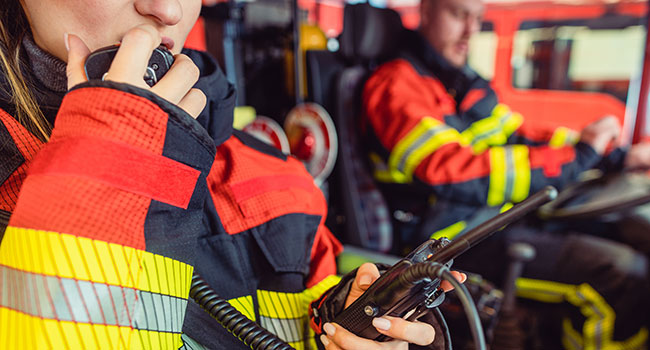
Radio communications link emergency responders to enhanced systems
For a first responder rushing
into a building emergency,
losing communication with
their teams inside or outside
of the building can be
terrifying. In fact, according to an IAFC
(International Association of Fire Chiefs)
2017 survey by Safer Buildings Coalition,
94% of surveyed first responders say
reliable in-building communications is
critical or frequently important during
emergencies.1,2
Yet, 98.5% report dead spots in
buildings, and 56% have experienced
a communications failure over the last
two-year period.1,2 These dead spots and
failures not only impact communication
but directly affect first responders’
safety and, ultimately, the safety of the
individuals they’re trying to help—as on
9/11, when firefighters and police officers
could not properly communicate with
each other in the World Trade Center…
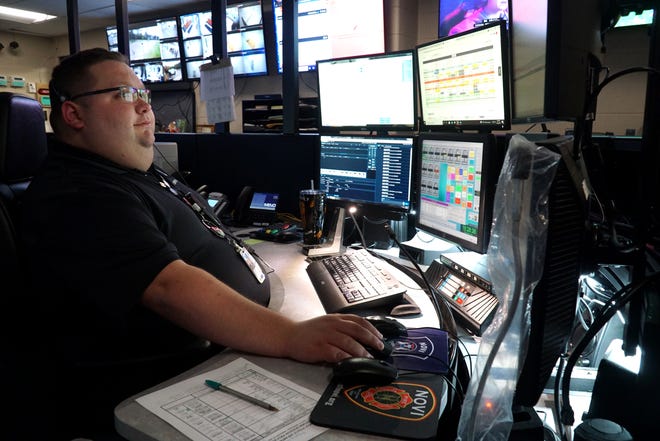
Charlie Jordan already had some dispatching experience when he reported for his first shift at Novi Regional 911 Center.
He was nervous and barely talked while absorbing the new policies and responsibilities that go with dispatching for the cities of Novi and South Lyon.
Some days were equally – if not more – nerve wracking, even for the trainers and supervisors who were perfectly familiar with how the job could deflate the strongest souls because of the long hours and stressful situations.
Jordan still remembers a particularly challenging day training on the police radio…
The Federal Communications Commission on Tuesday asked for proposals from those that want to coordinate frequencies in the 6 GHz band for standard-power unlicensed devices to avoid interference with incumbent users.
It comes less than two weeks after the regulator and AT&T faced off over unlicensed use in the 6 GHz band in oral arguments before the U.S. Court of Appeals for the D.C. Circuit.
Automated Frequency Coordination (AFC) was a topic that came up in AT&T’s appeal of the unanimous FCC decision and 2020 order that opened 1,200-megahertz of spectrum in the 6 GHz band for unlicensed users including Wi-Fi…
Learn about current efforts to continue to protect the 4.9 GHz Band for public safety as well as recent filings, key decisions impacting these efforts, and how you can support PSSA’s initiative to protect the 4.9 GHz band for public safety.